

Quick Summary
- Unexpected Art: A first-person view
The Past in Practice: Interpreting the Ancient World is on view on the first floor of the UC Davis Shields Library until the end of the quarter. Entering the library, past the left hallway beside the courtyard, on the first left wall near the stairs, the pieces hang elegantly. The exhibition shows works from students in the courses “Death and Dying in the Ancient World, Introduction to Neo-Assyrian Art” and “Fakes and Forgeries: The Art of Replication” taught by Classics Professor Biana Hand, approach antiquities in creative and factual ways. This mini exhibition artistically combines the practice of ancient material and the contemporary world.
Unexpected Art
An Arts Blog feature showing small corners of campus where you can find art if you know where to look for it.
“The project came about because my colleagues and I have been thinking of ways to move away from isolated long-form writing assignments,” said Bianca Hand, assistant professor of Classics.
“As someone who prioritizes object-based pedagogy, I wanted students to draw on what they know when engaging directly with material culture and to communicate their ideas in a more public-facing format. The exhibition gave them the opportunity to synthesize research, visual analysis, and interpretation in a way that feels both collaborative and accessible. It’s been exciting to see how they’ve approached the challenge.”
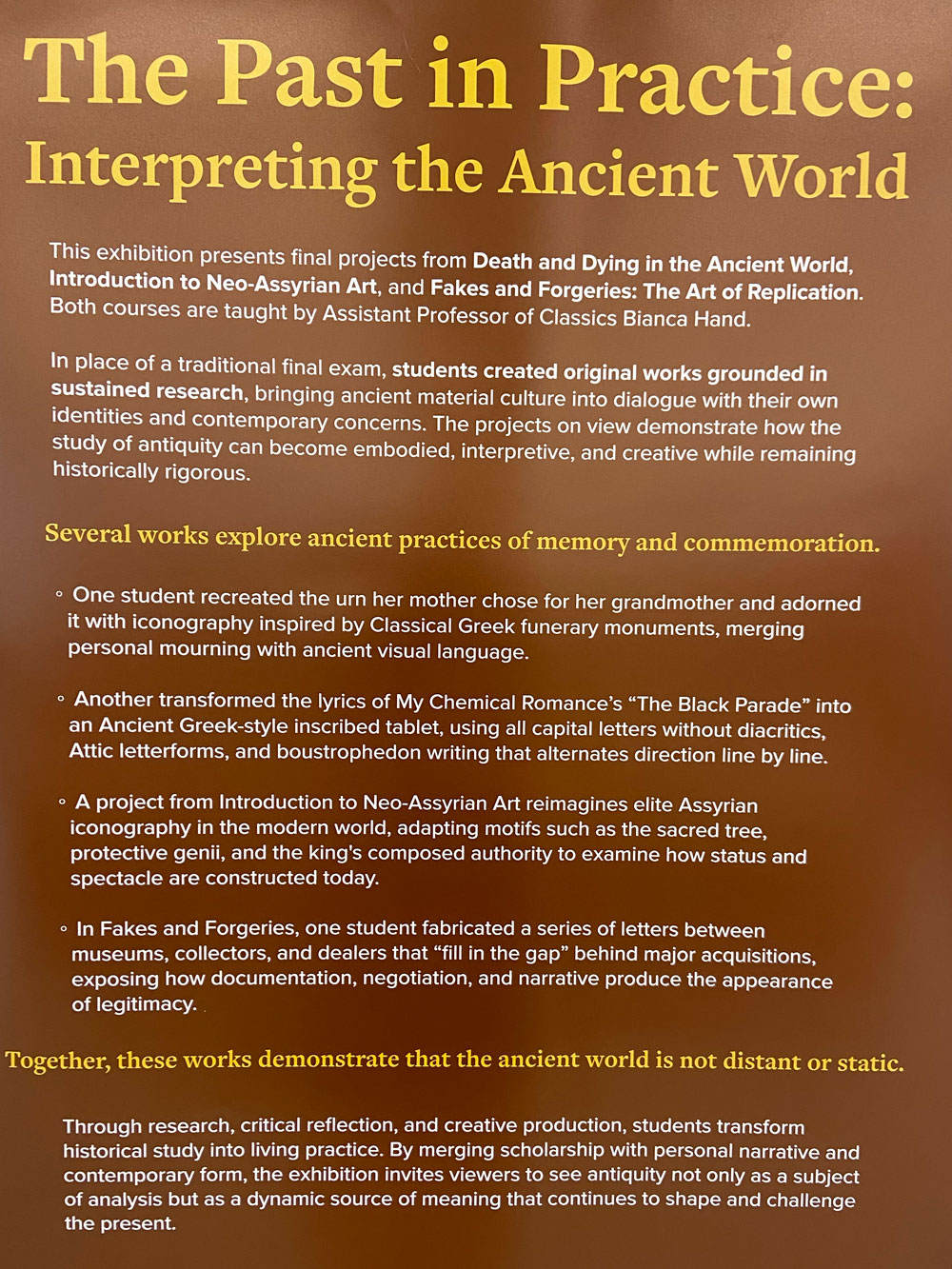
A total of 15 works hang closely between three sections of the wall, ranging from sizes smaller than printer paper to sizes double than printer paper. Each theme and goal is described comprehensibly in their labeling. The biggest group of works hang on the main wall inside of the niche; two larger pieces embed nine smaller works in the middle. Don’t miss the last piece on the wall outside of the niche, a reimagined propaganda drawing in a dark blue frame.
Each piece stands strongly as an individual work of art and takes a creative approach to the combination of Neo-Assyrian and contemporary culture. A piece that stood out to me was Faith, Oblivion, and Remembrance by Ravin “Alex” Schunk. The astounding contrast immediately catches one’s eye. This mixed media work portrays a decomposing body alongside a forest of growing plants. Interestingly, the life that grows and their placement is all in reference to customs and beliefs of the ancient world. “The angel wing mushroom growing from the corpse’s neck is representative of the ancient Greek idea of honorable suicide taken from Ajax.”
The fine brush strokes in the hatching provide the drawing with a lot of depth and visual interest. This is true especially against the solid black background, and the solid bright red color that fills the mushrooms, poppies and blood. The delicate detailing reveals more the longer you stare at the piece. From the small red writing in the trees, to the delicate white roots that grow between the black background, this piece speaks a lot of emotion into existence.
A couple pieces to the right, Neo-Assyrian Empire: A Curated Exhibition by Arianna Frenzel, hangs lower than eye level. As one of the five 3D models in this exhibition, this encasing models an exhibition space. Along the back wall of the model, three rows of miniature paintings in highly ornamented gold frames fill the space. All miniatures are inspired by Neo-Assyrian works, such as low relief stele. The left and right walls are almost mirrored with a palm tree in the far back corner, a miniature painting on top, and key items on the floor admired by "people." In the center, a miniature Black Obelisk rests on a platform in the middle of the room. Around this, multiple human statues are posed in a naturalistic way that imitates the way people may observe an exhibition in real life.
Lastly, the piece by Kaitlyn Valenzuela Asarmannesergon II for Prom King: Neo-Assyrian Propaganda Reimagined, closes off the mini exhibition. The piece is an imitation of the iconic Uncle Sam “I Want You” poster. Sitting on a bright yellow background, a black and white Neo-Assyrian styled drawing of a man imitates the Uncle Sam pose. Underneath the figure, the words “I WANT YOU to vote for Asarmannesergon II for Prom King” spans the bottom of the canvas. The comical approach to this propaganda poster cannot overlook the clever idea to use marker and ink to create the illusion of a Neo-Assyrian stone statue as the main figure in this piece. “This series humorously merges Neo-Assyrian propaganda with modern campaign posters, revealing how strategies of power and persuasion persist across time,” reads the description of the work.
Although small, and tucked in the corner of Shields Library, visiting The Past in Practice: Interpreting the Ancient World is worth finding between classes or while studying or taking a break from work. Not only does it provide a nice visual break, but it also provides a new insight to Neo-Assyrian culture and ancient material in general, bridging the gap with contemporary ideas.
Media Resources
Karen Nikos-Rose, Arts Blog Editor, kmnikos@ucdavis.edu