


Members of the UC Davis community are remembering the legacy of the legendary farm labor advocate Dolores Huerta, who died Wednesday (Oct. 28) at 96.
Huerta, a Stockton schoolteacher who became a labor leader after seeing the children of farmworkers come to school hungry or without shoes, went on to co-found the National Farm Workers Association, which would eventually merge with the Agricultural Workers Organizing Committee to become the United Farm Workers, or UFW.
Lorena V. Márquez, associate professor and chair of the Department of Chicana/o/x Studies, said Huerta was a role model who became synonymous with the Chicana/o movement, starting with her transition from teaching to labor organizing.
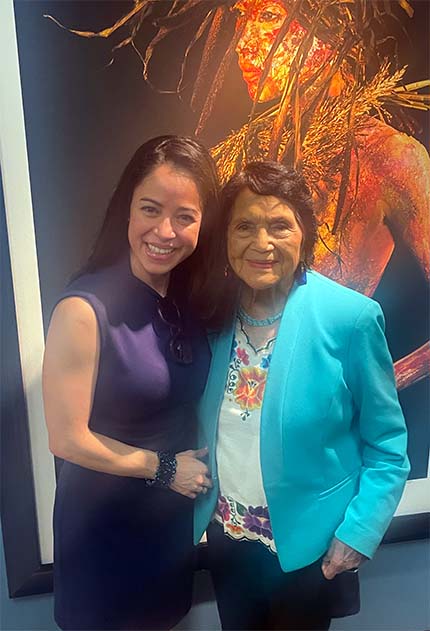
“I think she saw that there wasn’t much she could do to change the circumstances of the children, but she could change their circumstances and have a better impact by giving their parents a living wage so the children wouldn’t be hungry,” Márquez said as she prepared for a day of lectures in which she said she planned to discuss Huerta’s legacy.
“When I teach on the farmworkers movement, I give her equal status (to men like association co-founder César Chávez) in terms of leadership,” she said. “I call her the brains of the farmworkers movement.”
Huerta is credited with coining the phrase “sí, se puede” (yes, we can) and organizing boycotts of products like grapes, wine and lettuce.
Philip Martin, professor emeritus of agricultural and resource economics, served on the U.S. Commission on Agricultural Workers with Huerta and recalled her telling stories of early arguments with Chávez over what kind of boycott would have the biggest impact.
“Dolores was a charismatic leader, able to bring attention to the farm worker cause and advocate for changes,” Martin said.
Despite suffering broken ribs and a ruptured spleen at the hands of police during a 1988 protest in San Francisco at the age of 58, Huerta continued organizing and advocating into her 90s.
Márquez said her intersectionality was especially inspiring to Chicana women.
“She lived by example: You can get involved, you can be an activist, you can dedicate your life to a cause — all the while, you can be a mother and be smart, and have a degree,” she said.
UC connection, continuing work
Huerta was appointed in 2003 to serve out the last six months of a term on the UC Board of Regents, and made several visits to UC Davis over the decades for rallies and speeches. She gave the Cruz Reynoso Keynote Address at the School of Law in 2006 as part of a week of activities organized by the La Raza Law Students Association, now known as the Latinx Law Students Association.
RELATED
Kevin Johnson, distinguished professor of law emeritus, director of the Aoki Center and professor emeritus of Chicana/o/x studies, recalled seeing Huerta speak at King Hall in 2006, as well as on several other occasions at UC Davis. Johnson also served with Huerta on an advisory board for the exhibit “Help Wanted/Leave Now: ‘Operation Wetback’ and the Revolving Door of Mass Deportation,” on display through Jan. 10 at the California Museum in Sacramento. He said at the opening of the exhibition, Huerta told the audience that “change to the current immigration measures could be achieved through commitment and activism,” ending by leading attendees in a “sí, se puede” chant.
Johnson called Huerta a “perfect role model” for all and said her death is a great loss.
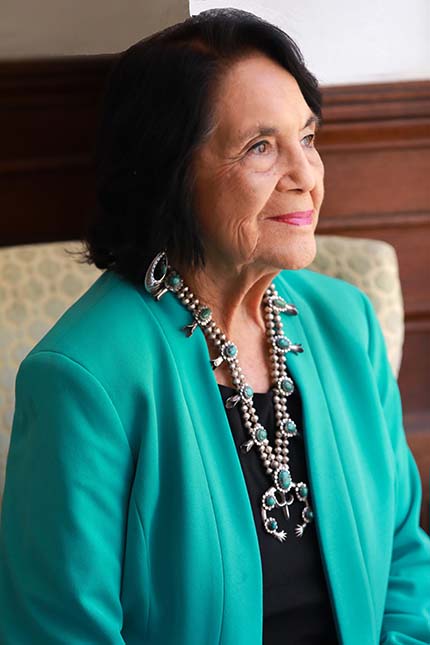
“She lived a life of trying to achieve justice for farmworkers, one of the most marginalized groups in U.S. society,” Johnson said. “Her activism came at a cost, and she made many sacrifices as she established the United Farm Workers and led it through many struggles.”
Those visits to campus also inspired Amagda Pérez, senior continuing lecturer in the School of Law and co-director of the Immigration Law Clinic. Pérez said she met Huerta as an undergrad, when the activist visited UC Davis to speak about ways to support students from farmworker and rural communities. Pérez said Huerta urged students to return to their communities as professionals after graduation to further advance civil rights, and to treat the members of those communities as partners, not clients.
“Through Dolores’ perspective, I saw and felt my own power, connected to the power of my community, to bring about the changes we knew we needed to address the injustices we lived,” Pérez said. “Being with Dolores always inspired a recognition that we are best and most impactful when we are part of something bigger than ourselves.”
Mayté Frías, director of Avanza, recalled meeting Huerta last year at a ceremony at the Mexican consulate in Sacramento, which had named a gallery after the activist. Frías said Huerta was quick to set aside a bouquet of flowers given to her for her birthday, focusing instead on her continued work.
“As always, she graciously listened to others acknowledge her legacy but as soon as she got the mic she was at work,” Frías said. “There was an election coming, so she spent her time educating the audience on how to organize collective action, explained some propositions on the ballot and urged others to exercise their right to vote.”
Professor Maceo Montoya, a writer and visual artist who teaches courses on Chicana/o culture, recalled Huerta attending an afterparty in Fresno a few years ago.
“It was way past 10 p.m. At 93 years old, she led everyone in a tequila shot and then told one of the poets in attendance, ‘Well, if you’re a poet then let’s hear you read a poem.’ It ended up being one of the best readings I’ve ever been a part of,” Montoya said. “Dolores sat front and center, her face beaming while one by one we read our work. We were performing for Dolores, for the grandmother of our movement. Decade after decade, she had been bringing people together in common cause. I’m wary of deifying our leaders, but to be in Dolores’ presence was to experience a unique and special power.”
Media Resources
Cody Kitaura is the editor of Dateline UC Davis and can be reached by email or at 530-752-1932.