

William Shakespeare wrote, “All the world’s a stage.” But what would the late-16th-century playwright’s work look like in the virtual world?
A collaboration at the University of California, Davis, among the DataLab, the ModLab and the Department of English is giving undergraduate students the chance to find out.
In Professor Gina Bloom’s spring course, “Interactive Shakespeare: From VR to AI” (ENL 187A), students don virtual reality headsets and step into the Bard’s plays, transforming centuries-old texts into immersive, embodied experiences. The course — which is housed within Peter J. Shields Library’s DataLab and will be offered next in fall 2026 — places students center stage in a new kind of literary experience.
“I feel like Hamlet is looking right at me!” UC Davis fourth-year student Eva Adams exclaimed about viewing Hamlet’s famous soliloquy in virtual reality.
How virtual reality enables immersive learning
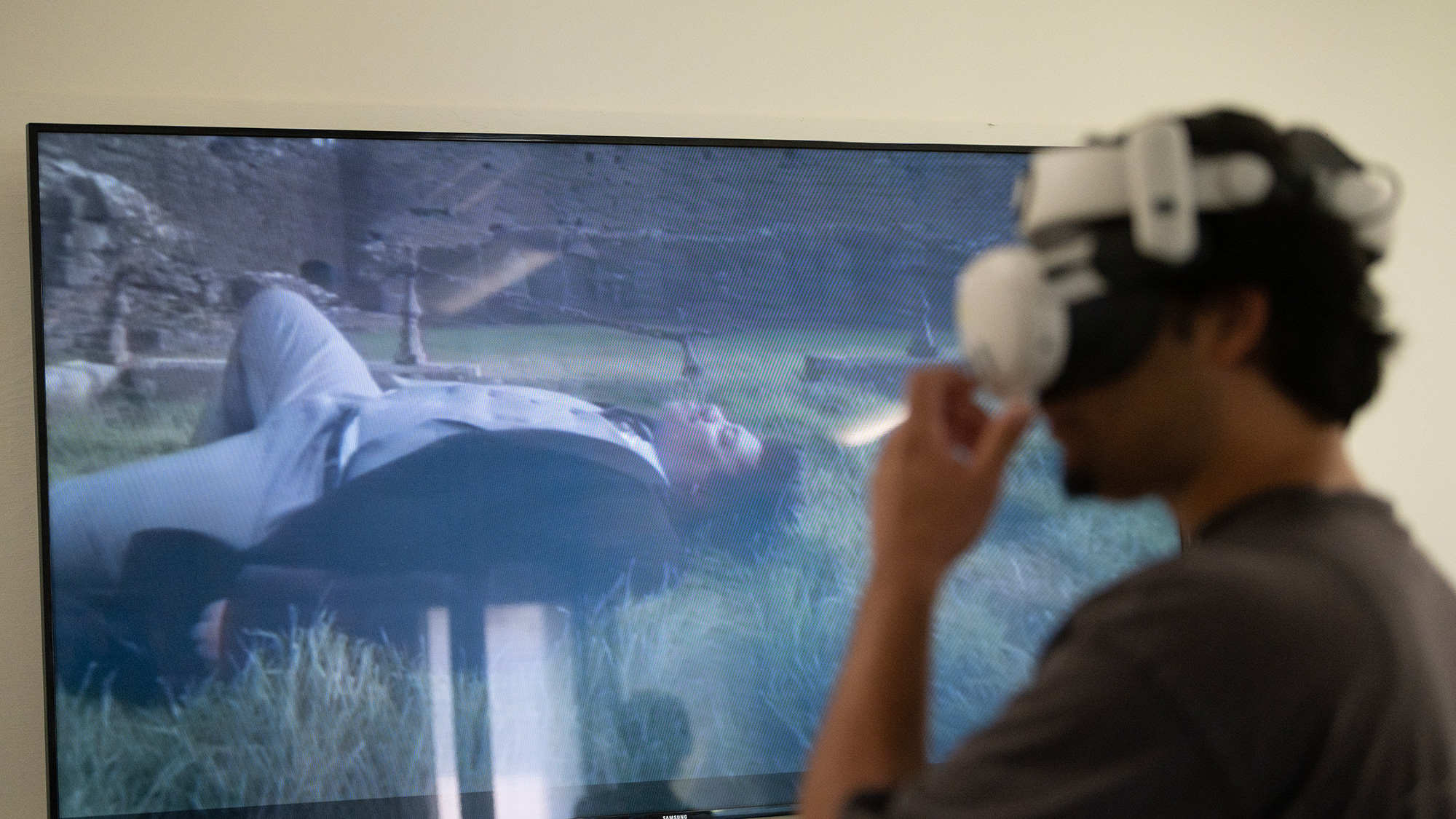
From across the room, the scene unfolding on the third floor of Shields Library is deceptively simple. Students sit or stand, headsets covering their eyes, controllers in hand, tilting and craning their heads as if tracking something just out of sight. There are no costumes, no props, no stage lights.
Inside the headset, however, the experience comes to life.
Students are transported into fully realized environments, from a historic theater to a castle in Ireland that is the setting for one company’s production of Hamlet. In one moment, they are seated among an audience watching Hamlet deliver his famous soliloquy. In the next, they are standing within the action itself, able to move, observe and interpret from inside the world of the play.
For Adams, who had never taken a Shakespeare class before, the shift of perspective was immediate.
“It felt like you were in the movie,” she said. “I was able to walk around like I was in the center of the production… I could really see the distress Hamlet was in because I was in the middle of the action.”
Even small details land differently. At one point, Adams recalled, a character in the VR production threw an apple. “It felt more real than just reading the stage direction [Hamlet throws apple] in the text,” she said.

How multimodal learning makes Shakespeare easier to understand
Bloom’s approach is designed to address a long-standing challenge. For many students, Shakespeare’s language can feel distant or difficult when encountered only on the page.
“The meaning of a line from Shakespeare is dependent on the actor who embodies it, the space in which it is performed, and the audience that receives it,” Bloom said.
Virtual reality helps restore those dimensions. By placing students inside a scene, the technology allows them to engage with the text through movement, proximity and perspective, not just language.
“I think it made the text a lot more understandable,” said Emmanuel Deharo-Cervantes, an English major who took the class last year and is now Bloom’s student intern. “Oftentimes we read the plays, but they are meant to be acted out. You can really feel what Shakespeare wanted you to experience.”
That immersive experience also can deepen emotional understanding.
“When you are watching Hamlet 360, you understand more about why Hamlet is contemplating suicide,” he said. “You can empathize a lot more. You feel more present in the moment.”
Bloom describes this as embodied, multimodal learning, an approach that reflects how students take in information. The course itself is an experiment in how students learn. Bloom intentionally exposed students to different media forms, having them read the plays, view recorded stage performances, play Shakespeare games, and even create their own mixed reality productions, in addition to exploring Shakespeare through VR.
“No student is a brain in a box,” she said. “They learn best when information is presented in multiple modes. And while many teachers have figured out how to enliven lectures with audio and visuals, we too often forget about kinesthetics.”
Her research on the results from the first course, which was offered in spring 2025, reinforces that idea. Students who directly experienced immersive performances were able to grasp complex concepts from a glossary of academic terminology more fully than those who only read about them. In some cases, students demonstrated understanding of key academic terms simply by engaging with the virtual environments, even before formal instruction.

Learning by stepping inside the text
The software used in the VR headset draws from projects created by a range of artists and academics, including several immersive experiences developed by faculty and staff of the UC Davis ModLab and the Center for Artificial Intelligence and Experimental Futures.
This intentionality to integrating experiential learning technologies into the classroom is central to the DataLab’s mission, which supports innovative research and cultivates spaces where new forms of instruction and scholarship can take shape. As Executive Director Carl Stahmer puts it, the DataLab exists to help scholars leverage new technologies and implement them into scholarship and experimentation, giving faculty and students the infrastructure they need to explore what’s possible.
“There’s just something about the immersive experience that becomes liberating for students. They will experiment and try things with a fervor and sense of freedom that, as faculty members, you want them to do, but they are extremely reluctant to do in the real world,” Stahmer said. “It has a way of stripping away their inhibitions so that they can truly explore.”
Using VR to teach Shakespeare is just one example of the multidimensional virtual reality environments available to students and scholars at UC Davis. The DataLab also creates customizable, fully functional systems for researchers to analyze and experiment with three-dimensional datasets in a virtual environment. Taking data off the page and putting it into an immersive, 3D setting opens up a whole world of exploration for researchers, allowing them to investigate everything from atoms to massive geographical formations in a more native environment.
DataLab makes more forms of research and learning logistically and financially feasible for many students and scholars alike. In Bloom’s case, providing her students with a comparable experiential learning opportunity in physical reality would have been cost-prohibitive. Stahmer noted that conducting research in virtual reality can also offer opportunities for physically impaired scholars to interact in previously inaccessible environments.
The DataLab provides the physical space, technical infrastructure and behind-the-scenes support required to run immersive learning at scale. Those requirements could have become barriers, but in the DataLab, Bloom can run multiple VR stations simultaneously, store equipment between sessions and move fluidly among students engaged in different stages of the experience.
“I could never have taught this course without the DataLab,” Bloom said.
How VR might change the modern classroom
For many students, that shift in learning modes has changed how they think about literature.
“It feels like you are right on the front of the stage,” said Michael Fenenga, a fourth-year psychology major. “It feels even more immersive than watching videos because the closeness is the most important part… It does feel like you are there.”
Students are also beginning to see how immersive technologies could extend beyond Shakespeare to reshape how other complex texts are taught.
“I could see this being used in other classes, too,” Adams said. “Imagine reading Milton or Chaucer and hearing from those authors using VR. It would make it so much easier for a lot of people to understand what’s happening.”
The course also expands how students think about their own futures.
Before taking the class, Deharo-Cervantes said he struggled to see how his interests in storytelling and technology could intersect.
“Before this class I thought being an English major just meant I would go to law school or be a teacher,” he said. “Now I see there are a lot more options available to me.”
Using Shakespeare to explore conflict de-escalation
The implications of the course extend beyond UC Davis.
Bloom is working on a project at the UC Davis Center for Artificial Intelligence and Experimental Futures to develop a new interactive VR experience that uses Shakespeare’s tragedies to help teach nonviolent conflict resolution. Through the program, which is still in the prototype phase, students interact with such characters as Macbeth or Juliet’s father Lord Capulet in a simulated environment and practice how to de-escalate moments of conflict before they turn violent.
Students in the previous year’s course were the first playtesters of the game’s Macbeth prototype and students in the current course are the first playtesters of the Romeo and Juliet prototype. Their feedback is informing how the game will eventually be used to teach nonviolent conflict resolution in South African and U.S. schools.
The work reflects Bloom’s broader focus on applied theater, using performance and storytelling to influence human behavior and decision-making.

A new way to experience classic literature
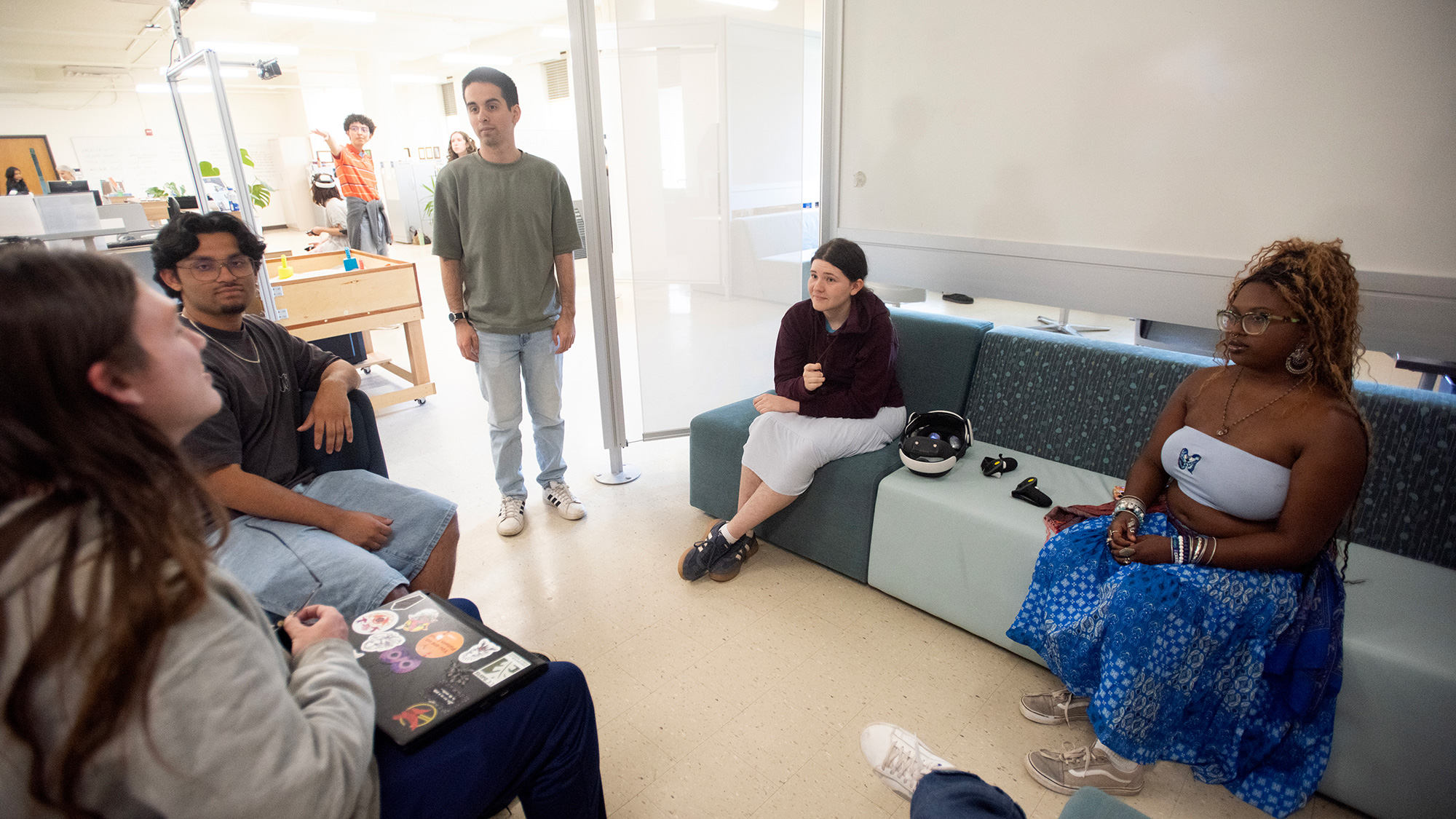
As the class session winds down, students remove their headsets and step back into the room. Conversations pick up quickly, comparing interpretations, reactions and moments that stood out. For a brief time, they have not just read Shakespeare. They have lived it.
The technology may be new, but the goal is not. At its core, the course returns to a fundamental idea of Shakespeare’s work. His plays are meant to be experienced as much as they are read.
“You can really feel what Shakespeare wanted you to experience,” Deharo-Cervantes said.
For students like Adams, that deeper understanding is part of what makes the class so compelling.
“It’s fun and interesting,” she said. “I’m excited to see what we are going to do next.”